

What Indonesia’s 2026 Wage Adjustments Mean for Singaporean Business Strategy and Regional Hiring
Indonesia’s 2026 minimum wage hike, driven by PP No. 51/2023, represents a major cost and compliance shock for Singaporean businesses. Batam’s UMK (city minimum wage) has risen to Rp 5,357,982 (~SGD 413), placing it among Indonesia’s most expensive labour markets. With criminal penalties for underpayment and narrowing cost differentials, Singapore SMEs must pivot from cost-driven hiring to value-driven talent strategies—making informed, compliant platforms more critical than ever.
Wah, 2026 Indonesian wages really naik (increase sharply) until many Singapore bosses will surely ask, “Siao ah, still cheap or not?” The answer is no longer a simple yes or no. It is strategic, regulatory, and increasingly unforgiving.
Indonesia’s newly finalised minimum wage framework for 2026 redraws the labour cost map of Southeast Asia. For Singapore SMEs and regional operators long accustomed to tapping Indonesia—especially Batam—for cost-efficient manpower, this is not a routine adjustment. It is a structural shift that forces a rethink of hiring, expansion, and compliance strategies across the region.
Another year, another headache for finance and HR. Singaporean founders, CXOs, and operators—this one deserves your full attention. The Indonesian government has officially locked in its Upah Minimum Provinsi (UMP), meaning Provincial Minimum Wage, and Upah Minimum Kabupaten/Kota (UMK), meaning City or Regency Minimum Wage, for 2026. The increases are material, the enforcement is real, and the consequences of misreading the numbers are severe.
This is not just a pay rise. It is a recalibration of Indonesia’s labour market—and the era of “ultra-cheap” Indonesian labour is closing fast.
Indonesia’s 2026 minimum wage structure was finalised under Government Regulation (PP) No. 51 of 2023 on Wages (Peraturan Pemerintah, a binding government regulation). This regulation applies a formula combining inflation, economic growth, and an adjustment coefficient known as alpha, producing significant—often high single-digit to double-digit—increases nationwide.
Official announcements were released between late 2025 and early January 2026, setting a higher operational baseline for employers across the archipelago. For Singapore SMEs and MNCs with Indonesian operations or supply chains, understanding the distinction between UMP (provincial minimum wage) and UMK (city/regency minimum wage) is no longer optional. It is existential.
The Battle Lines Are Drawn: UMP vs UMK
Indonesia operates a two-tier minimum wage system—frequently misunderstood by foreign employers and often underestimated in impact.
1. UMP: The Provincial Floor
The Upah Minimum Provinsi (UMP), or Provincial Minimum Wage, is the minimum legal wage applicable across an entire province, unless a higher city or regency wage applies. It is set by the provincial governor and functions as the baseline safety net for workers.
For Kepulauan Riau (Riau Islands) Province, the 2026 UMP is Rp 3,879,520, equivalent to approximately SGD 299 per month. This represents a 7.06% increase year-on-year—already significant by regional standards.
2. UMK: Where the Real Cost Hits
The Upah Minimum Kabupaten/Kota (UMK), or City/Regency Minimum Wage, overrides the UMP in economically active cities and industrial hubs. It is proposed by local mayors or regents and approved by provincial governors, reflecting higher living costs and stronger labour demand.
For most foreign-backed businesses, UMK—not UMP—is the number that directly impacts payroll. The widening gap between UMP and UMK exposes Indonesia’s sharp internal economic fragmentation. Ignore it, and you risk regulatory breaches, labour disputes, and unexpected cost overruns.
Indonesia’s Most Expensive Labour Markets in 2026
The 2026 UMK rankings reveal an uncomfortable truth: Indonesia’s industrial centres are no longer low-cost havens.
At the top sits Kota Bekasi (City of Bekasi), with a 2026 UMK of Rp 5,999,443, or approximately SGD 462 per month—now the most expensive labour market in Indonesia. At the other extreme, regions such as Banjarnegara Regency remain at Rp 2,320,000, around SGD 179 per month. The disparity is stark—and strategic.
Selected 2026 Minimum Wages
These increases stem directly from the new wage formula under PP No. 51/2023. Labour unions argue the hikes still lag behind Kebutuhan Hidup Layak (KHL), meaning Decent Living Needs, while employers warn of eroding competitiveness and factory relocation risks.
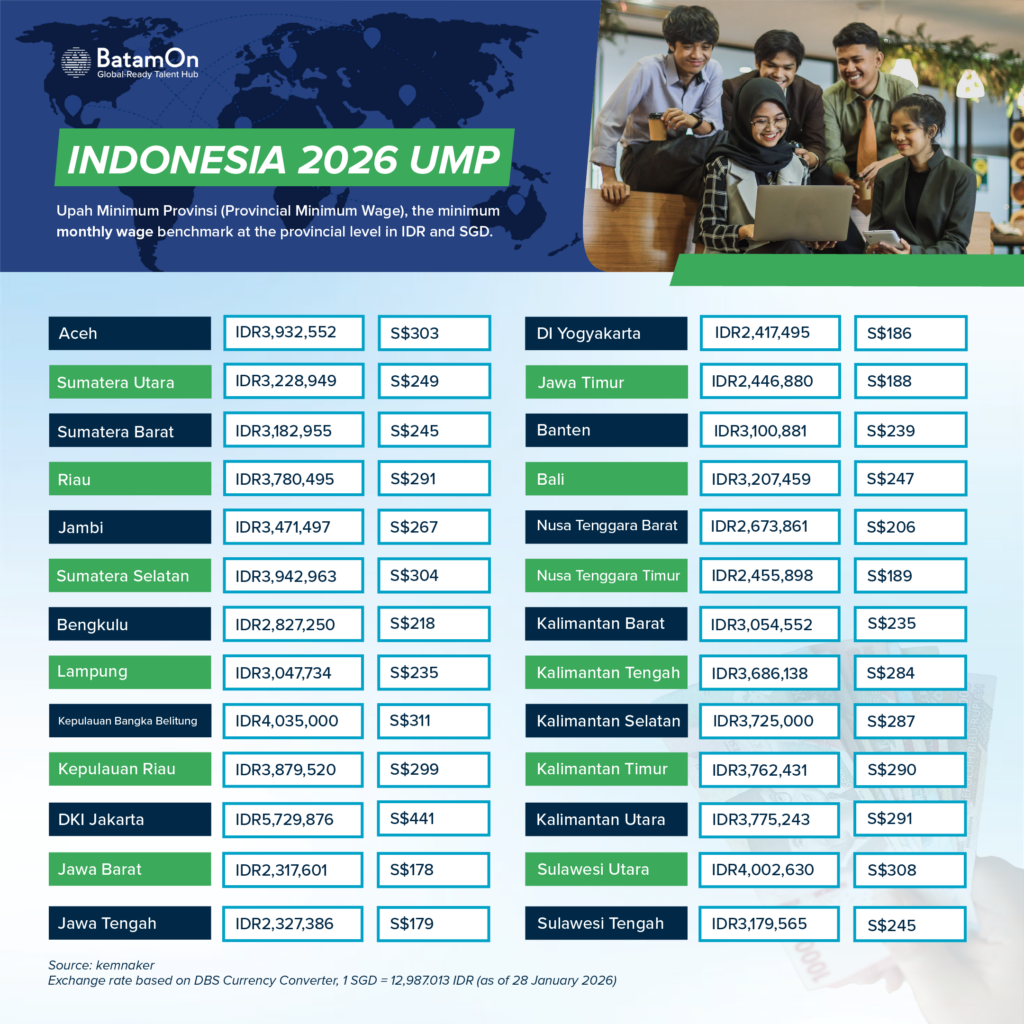
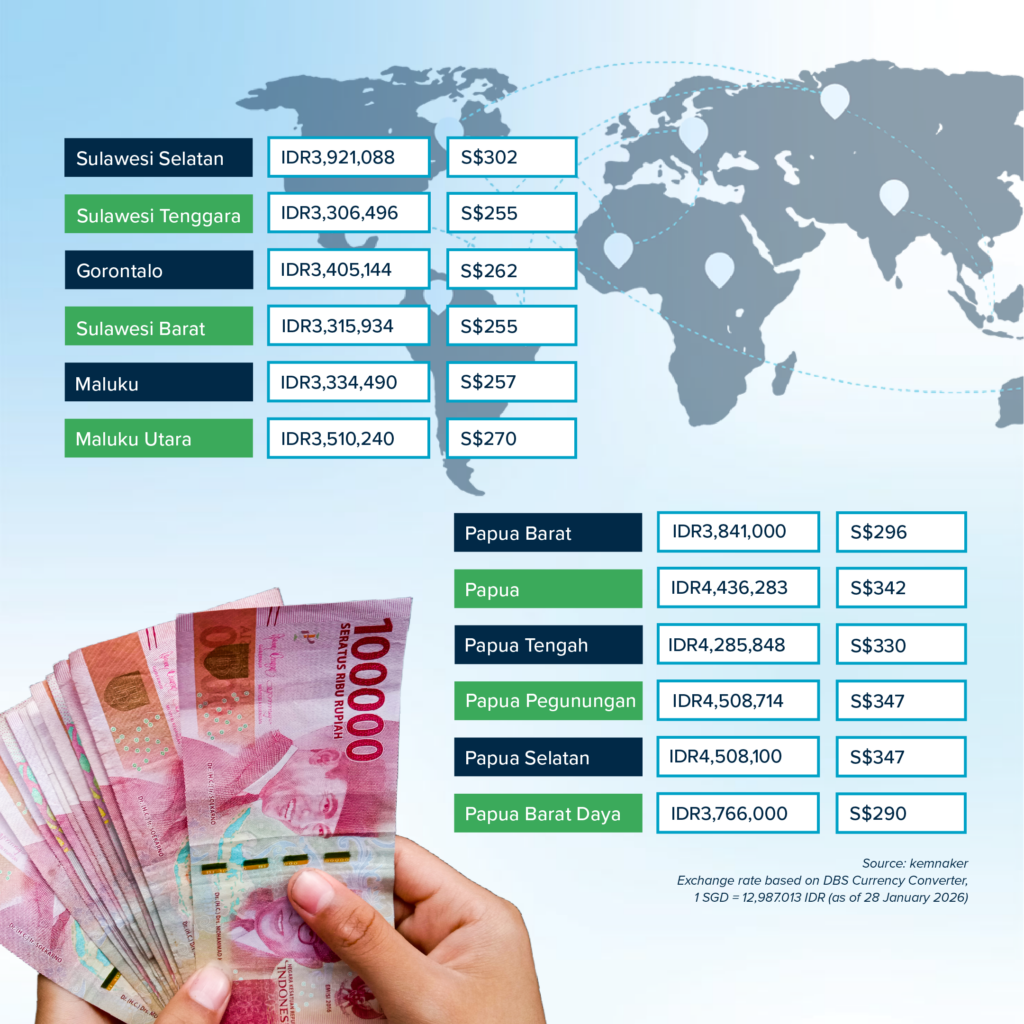
The annual wage-setting cycle—proposals in October, debates in November, ratification in December—has become a high-stakes ritual with direct balance-sheet consequences.
Batam’s Explosive Wage Growth
For Singapore businesses, one number matters most: Batam.
The 2026 UMK for Kota Batam (Batam City Minimum Wage) stands at Rp 5,357,982, approximately SGD 413 per month. Batam now ranks as the 9th most expensive labour market in Indonesia—and the only non-Java city in the top ten.
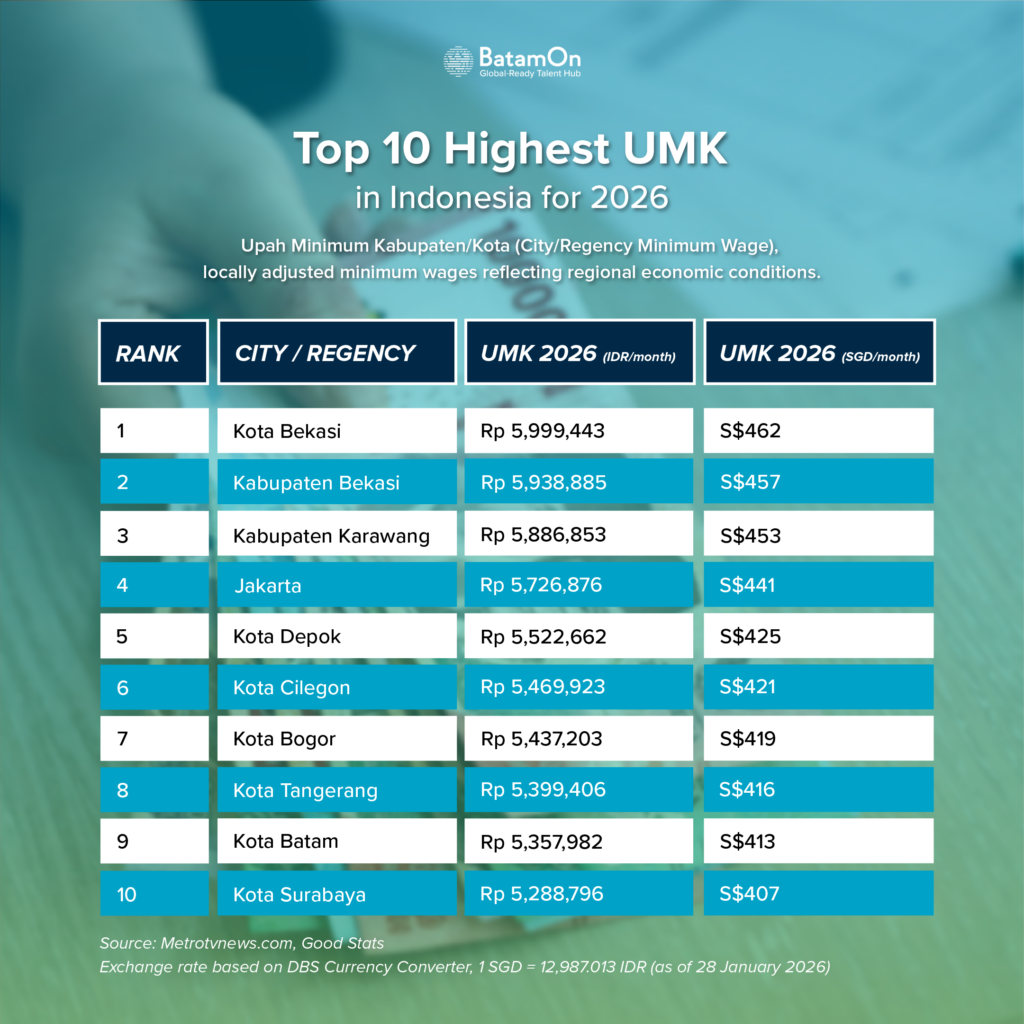
Batam’s wage level now sits far above its provincial UMP and continues to rise due to proximity to Singapore, dense foreign investment, and a higher cost of living. Local authorities, under sustained pressure from serikat pekerja (labour unions), have consistently pushed for maximum permissible increases.
The cost gap between Batam and Singapore is narrowing. The old narrative—“hire in Batam, save big”—no longer holds without qualification.
Non-Compliance Is Criminal
Indonesia’s wage rules are not advisory. They are enforceable law. Under Article 81 point 63 of the Job Creation Law (UU Cipta Kerja)—Indonesia’s omnibus Job Creation Law—employers are strictly prohibited from paying below the applicable UMP or UMK.
Violations carry criminal penalties:
– Imprisonment: 1 to 4 years
– Fines: Rp 100 million to Rp 400 million
(approximately SGD 7,700 to SGD 30,800)
Exemptions apply only to Usaha Mikro dan Kecil (UMKMs), meaning micro and small enterprises, under specific conditions—not to most Singapore-backed SMEs or MNCs operating in industrial zones. For foreign employers, this is not a theoretical risk. It is a regulatory red line.
The Strategic Question Singapore Leaders Must Face
With Batam’s UMK now above SGD 400, Singaporean business leaders must ask a hard question: Is your Indonesia strategy still built on value—or just habit?
Rising wages are only part of the story. The deeper challenge lies in navigating a fragmented labour market where costs vary dramatically by location, and compliance failure carries criminal exposure.
The solution is not to exit Indonesia. It is to evolve.
The future belongs to companies that move beyond chasing “cheap labour” and instead secure high-impact, compliant, well-matched talent that justifies the investment. This is precisely where platforms that understand Batam and cross-border hiring dynamics become essential—not optional. For organisations reassessing their approach, start by grounding your strategy in the right local context. You can explore more insights and resources on this at our homepage.
Sources:
[1] Daftar Lengkap UMP 2026 se-Indonesia, Cek Upah Minimum Terbaru Tiap Provinsi
[2] Cek UMK Tertinggi 2026 di Indonesia, Kota Kamu Nomor Berapa?
[3] Inilah 10 Kabupaten/Kota Dengan UMK 2026 Tertinggi di Indonesia
[4] Daftar UMP 2026 di 38 Provinsi Indonesia dan Hukum Perusahaan yang Beri Gaji di Bawah UMP